





Voir toutes les actualités


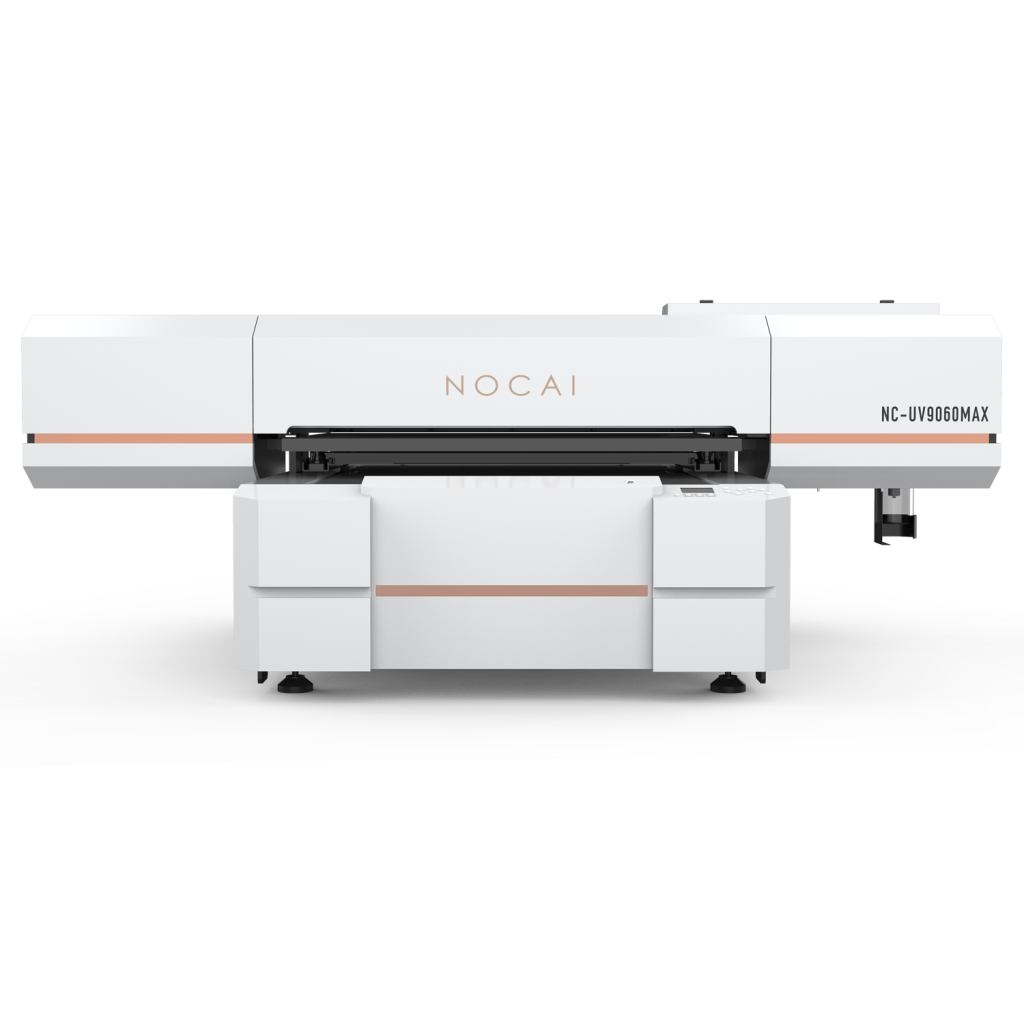


UV 6090-Max
From: 28800 €
The UV 6090-Max is a latest-generation digital printer designed to provide exceptional print quality on a wide variety of substrates.
Equipped with a CCD camera registration system, it automatically detects the position and orientation of objects, ensuring uniform marking without the need for positioning jigs. This technology significantly reduces alignment errors and guarantees optimal consistency in production processes.
Thanks to its integrated primer application system, the 6090-Max can improve ink adhesion on difficult materials such as glass or metal, while supporting printing on irregular surfaces (concave or convex) with height variations between 2 and 12 mm without loss of precision.
The multi-layer printing feature allows for embossed markings and high-end finishes, adapted to the most demanding professional requirements.
Robust, precise, and reliable, the UV 6090-Max stands out as a complete solution, ideal for production environments where performance and quality must go hand in hand.
Number of colours:
Une couleur
Multicouleurs
Shape:
Forme relativement plane
Forme cylindrique
Quantity:
Single
Series
Materials:
Discover...
Technical sheet
Featuring a CCD camera registration system, an integrated primer application, and multi-layer printing technology, the UV 6090-Max guarantees optimal precision, excellent adhesion on all surfaces, and professional print quality, even on irregular surfaces.
Features:
Printing surface
600*900 mm
Maximum printing thickness
0-180 mm
Camera
CCD visual registration camera
Print heads
4 print heads / 8 color channels
I3200-U1 for white (WH)
I3200-U1 HD for colors (CMYKLcLmLKLLK)
I1600-U1 for varnish (V)
I1600-U1 for primer (PR)
Printing technology
Piezoelectric
Printing types
Primer – White – Color – Varnish
Printing modes
CMYK
CMYK + WH
CMYK + V
CMYK + WH + V
PR + CMYK
PR + CMYK + WH
PR + CMYK + V
PR + CMYK + WH + V
Resolutions
720*900 dpi – 720*1200 dpi
Printing speeds
In high resolution full surface:
Color: 18.22 min
Color + White: 19.03 min
Color + White + Varnish: 19.45 min
Print head projection height
2-12 mm
Lamp technology
Air-cooled UV
Inks
Semi-flexible UV
Software included
Flexiprint
Interface
Ethernet
Operating system
Windows
Accepted graphic formats
TIFF – JPG – EPS – PDF – PNG – AI – PSD
Compatible software
CorelDRAW – Photoshop – AutoCAD – Inkscape or any software capable of exporting to supported file formats
Machine dimensions
2000*1355*790mm
Weight on table
25 kg max
Machine weight
250 kg
Power supply
AC 220 V / 470 W
Environment
20 – 28 °C
Humidity 35 % – 65 %
Option
Motorized rotary device for printing cylindrical objects from 30 to 120 mm max
CCD Camera Optical System
Scan format: 900*600 mm
Scan precision: 0.1 mm
Camera recognition height: 0-8 mm
Table acquisition time: 90 secs
Accessories available with this product
Examples of applications using this product
Find out what this product can be used for.




FAQ on UV 6090-Max
What are the advantages of UV printing?
The main advantages of UV printing:
- Versatility of Substrates: works on plastic, metal, wood, glass, paper…
- Instant Drying: the ink hardens immediately under UV light, reducing smudges and allowing for quick use.
- Quality and Precision: excellent definition, fine details, and vibrant colors.
- Possible Special Effects: varnish, embossing, textures, or translucent inks.
- Environmental Friendliness: inks are often solvent-free and have low VOC emissions.
- Direct Printing: no need for intermediate films or plates, even for small runs.
- Production Flexibility: UV printing allows for both single-unit printing and the production of small or large series, without additional costs for intermediate plates or films.
What substrates can be UV printed?
The great strength of this process is that it can be applied to a very wide variety of substrates, whether rigid or flexible, transparent or opaque.
• Plastics: acrylic, PVC, polycarbonate, ABS, PETG…
• Wood and MDF: raw or varnished panels, wood veneer…
• Metals: aluminum, steel, stainless steel, brass (with prior application of an adhesion primer)
• Glass and Ceramics: bottles, jars, plates, tiles
• Plastic Films: polypropylene, PET
• Cylindrical Objects: thanks to the rotary attachment option, it is possible to print directly on bottles, water bottles, mugs, tubes, vials, and other cylindrically shaped objects.
How to perform UV printing?
The 4-step UV printing process:
- Setup/Alignment: Placing objects on the plate. Using custom jigs allows for precise positioning of multiple pieces for serial production.
- File Preparation: The visual (created in Photoshop, Illustrator, etc.) is processed by RIP software, which refines color management, resolution, and print data formatting.
- Configuration and Launch: After adjusting the pattern, the file is sent to the machine. The machine automatically adapts its settings to the thickness of the piece.
- Immediate Finishing: As the ink polymerizes instantly, products are ready immediately after exiting the machine and can be handled without interrupting the printing cycle.
What are the limitations of UV printing?
The main limitations of UV printing:
r
r
- r
- Limited Substrate : although versatile, certain very flexible, very rough, or porous materials can pose problems.
- Layer Thickness : the UV ink layer remains thin, which can limit coverage or the relief effect.
- Variable Durability : scratch or chemical resistance can sometimes be lower than that of other processes (except for specialized inks).
- Cost : UV equipment and inks are more expensive than traditional printing (inkjet or screen printing).
- Print Speed : for very large series, production can be slower than with conventional processes.
- Odor and Safety : some UV inks require ventilation or precautions, especially for industrial applications.
- Substrate Preparation : certain materials require prior application of an adhesion primer (primer) to ensure good adhesion and print durability.
- Relief Constraints : substrates with significant reliefs, pronounced hollows, or irregular surfaces can limit print quality and marking precision.
t
r
t
r
t
r
t
r
t
r
t
r
t
r
t
r
What are the UV printing speeds and costs?
Productivity and Profitability: What You Need to Know:
- Custom Production Rate: printing time varies depending on the resolution, visual size, and pattern (empty areas are automatically ignored).
- Cost Control: our RIP software precisely calculates the amount of ink and the cost of each print.
-
UV Speed: variable depending on the substrate and level of detail, ranging from slow production for complex markings to a sustained pace for simple prints.
- Cost per m²: generally higher than solvent, variable depending on the options chosen (white ink printing, varnish application, etc.).
- Cylindrical Objects: UV printing allows direct marking of cylindrical objects using the rotary tool; however, the production rate may be slightly reduced when using this option.
- Profitability: ideal for small and medium series with high-quality and durable results.
What is the Nuocaï UV printer range?
The Nuocaï UV printer range comprises compact and versatile machines, ideal for object customization and printing on a wide variety of substrates.
- UVA3 Max: compact format, ideal for small productions and object customization.
- UV6045-I1600: intermediate print area offering an excellent compromise between footprint and productivity.
- UV6090-I1600: versatile format suitable for many applications on rigid substrates and promotional items.
- UV6090 Max: equipped with a positioning camera allowing automatic object detection and jig-free printing, for time saving and simplified production setup.
This range is particularly aimed at artisans, SMEs, and customization professionals who wish to combine compactness, versatility, and print quality on a wide variety of substrates.
THERMOFLAN advantages
Over 60 years of experience
Permanent stock
Best quality/price ratio
Technical availability
Demandez conseil à nos experts
Comment pouvons-nous vous aider ?